
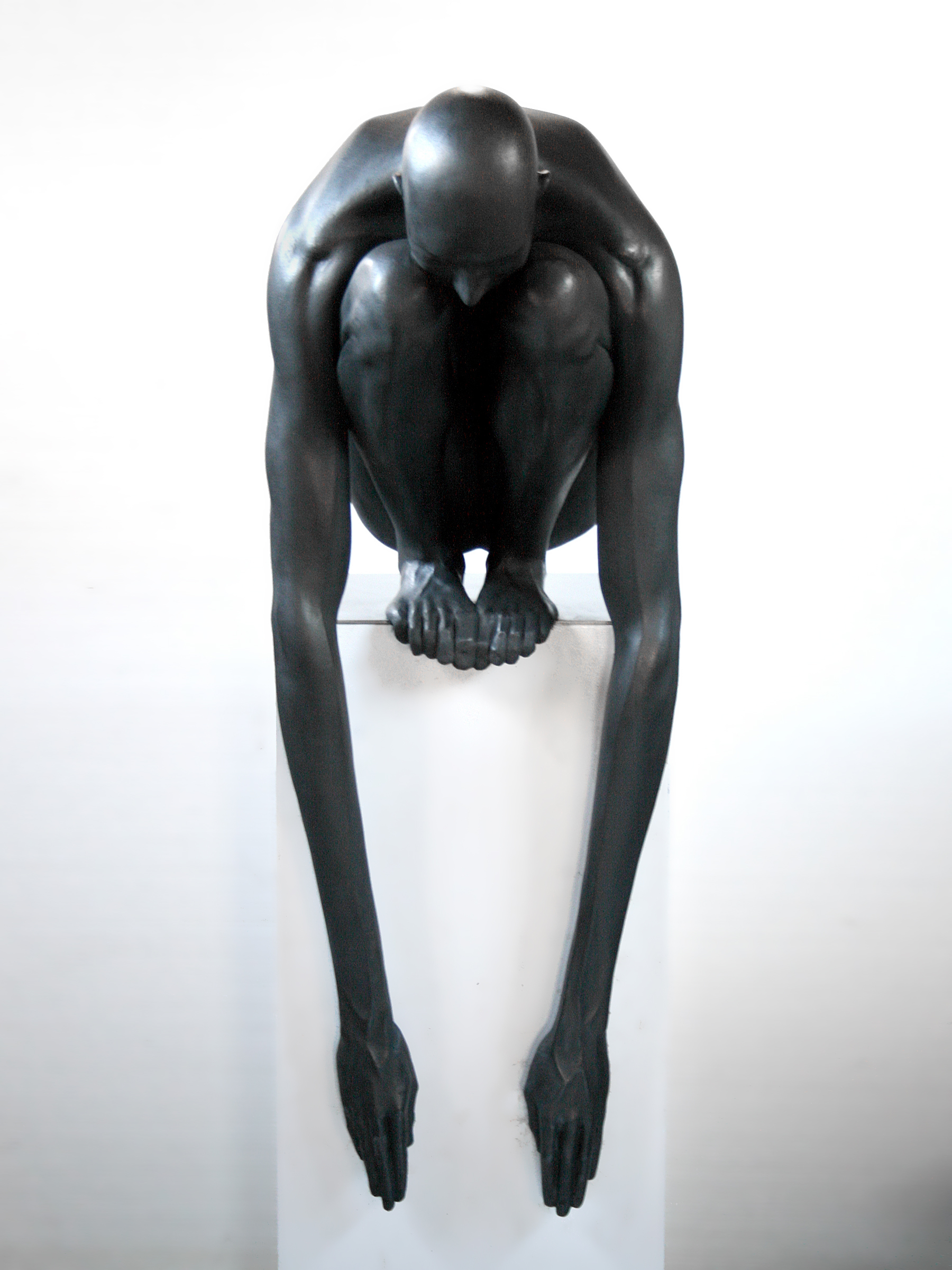
Abyss by Emil Alzamora
Contents
Sean Thomas Dougherty | Abubakar Ibrahim | Arjun Warrior | Kathryn Pratt Russell | Katherine Soniat | Jennifer K. Sweeney | Gloria Ogo | Israel Okonji | Molly Kirschner | Robert Fanning | Peter Cashorali | Kathleen McGookey | Matt Zambito | J.R. Solonche | Paula Reed Nancarrow | Tina Barr | Zoé Mahfouz | Kathryn Stripling Byer | Gibbons Ruark | Julie Suk
The Butchered Lamb
It must have been like this even in 1943
north of Budapest and my lost cousins
going about the day, gathering hay,
maybe a long stroll to the village store
to pick up nails, a new black hat,
or a butchered lamb in white paper.
And the stories were elsewhere,
someplace say like Rumania,
or Czechoslovakia, or Greece,
they were just stories my kuzeena
told as they sat around the white table
eating slices of roast lamb for Shabbat.
Those were just stories, no mind
to them, there was work to do
and the wheat needed to be threshed.
And not Palestine, no not there
nor in Los Angeles, nor Chicago,
no never, far away in the bright cities
in the new world or the yahrzeit lights
of Jerusalem where one emigrated
to escape the pogroms and the secret
police for now there are Israeli
cops in Jerusalem who beat Nanas
and push them out of apartments
and shoot Arab teenagers at checkpoints.
And here in our cities are the soldiers
with masks, and children kneeling
on the concrete with zip ties tied,
and then they are disappeared.
And where I ask, as in 1944, are my kuzeena?
Where were my lost tantenkes taken?
The ones my poppa sat with,
my lost onkel and his violin
outside of Uzhhorod, and the unnamed
shtetl, and the ghosts that followed?
I hear them rising all over the world
from the ghettos, and the rubble,
from the alleyways and the refugee camps,
and every time I see them floating
in the air, they are asking the same
questions, the ones I cannot answer
for all that we must bear.
Sean Thomas Dougherty’s many books include The Dead are Everywhere Telling Us Things from Jacar Press and Death Prefers the Minor Keys from BOA Editions. He works as a Medical Technician and Carer along Lake Erie.
Mornings That Feel Like Goodbye
(after Amy Winehouse)
The walls soaked in all the cruelty of the morning,
hold the soft violence of our silences. Amy sings
“Back to Black” on the stereo, & I wonder
how a voice can carry so much ache, how a body
can turn sorrow into velvet. We argued—nothing
spectacular, just the ordinary ache of two people
trying to hold love without breaking the bowl
that holds it. Still, the room tightens. Still, the light
slants in like a question. What frightens me isn’t
the fight; it’s what follows: how my mind slips
quietly into the murk of memory, searching for
the things we’ve hidden in the folds of laughter,
in the corners of touch. I hate these parts:
how silence becomes a room, a body of its own,
& how the mind begins to slip through cracks
on the floorboards, wandering into old rooms.
I’m afraid of what waits there; the versions
of me I’ve buried in dust, the truths I never
dared unwrap, the soft ache of everything
I’ve tried to forget:
my mother’s departure,
the taste of unsaid things,
the small griefs we carry
like folded letters in the pockets of the heart.
Memory, that reckless lover, keeps opening the
door, keeps asking what if, what now. & here I am,
again—in a room filled with silence & song, reaching
for a hand already letting go, watching love shape
itself into the distance. Still, I stay. Still, I listen.
Because maybe this too is love—not the joy,
not the spark, but the staying, the slow unfolding
of what we mean when we say forever on
mornings that feel like goodbye.
Abubakar Ibrahim, “Imam of Poets,” is a vector biologist, poet, and visual artist from New Bussa, Nigeria. Co-founder of Borgu Caravan, his work explores identity, memory, heritage, and communal histories. Author of The Book of Questions, selected by Danusha Laméris as the winner of the Jacar Press Chapbook contest, and The Inventory of Lost Things (Masobe Books 2026). His poems appear in Arts Lounge, Chapter House Journal, Fahmidan Journal, Konya Shamsrumi, and others.
We’re lying
In your bed when you ask me
What’s the last thing I usually think about at night
And fuck of course the answer is you
But instead I say hamburgers
So you laugh, like always, and say
“Oh right, yeah, me too”
And then you kiss me and
We get so silent
Like the quiet between waves
When morning comes and I hold you in the doorway
Tousled beauty, hair undone
I do not yet know that this is the last time
We will have this
That later, it will feel so ugly
All of it:
Dancing in your apartment
Trying to find you that day, in the rain.
Arjun Warrior’s poetry has previously appeared in the Yale Herald. He grew up in Southern California.
Down Inside the Bayeux
We power our lives with the bodies of the dead who came before us, reptilian creatures with little minds. Or are we running on Einstein, Curie, Faraday’s motor?
Museum day—I saw a new riff on the Bayeux Tapestry, with 100s of triceratops, raptors, stegosaurs. Cheerful doglike creatures when in miniature, yet also destroyers armored for battle.
The embroidered words were damning. Forming the sticky black oil seeping to the surface.
They call it the march of progress. But there was no marching, only a spill across the fabric from left to right: ships, pianos, derricks, fires.
In my house, cozied up with my computer, I am innocent. The lights and fans are minimal, the Spring is temperate.
On the great road, the bodies burn on, inside trucks with churning cylinders of fuel. Gasoline is mead, and should be honey-colored. Its fumes out-odor the strongest whiskey.
Science can’t protect us. The greatest geniuses we can invent will still be too late. Or just won’t want to stick out their metal hands and keep us from falling into the pit.
Our bodies will feed the hunger we invented. Our minds are nothing but wet brains.
Kathryn Pratt Russell has poems published or forthcoming in Gargoyle, Black Warrior Review, Free State Review, Atlanta Review, South Florida Poetry Journal, Birmingham Poetry Review, and elsewhere. Her chapbook of poems, Raven Hotel, was published by Dancing Girl Press. She lives in Decatur, Georgia.
The White Dog
sleeps hanging over the head of her bed
—unconcerned as he is with the gradations of light.
It’s just about time for him to come unframed over the
red rose etched at the headboard’s center. The dog wakes
from himself on the wall to walk down the dawn hall for a long drink
of water from the toilet bowl. Sprinkle of human pee mixed with dog
drool on the blue linoleum. This happens before he runs the fields
until evening most days—a dog freshly scented with what he recalls
his way house by. One twilight, he’s headed uphill—this white dog
who at times places toilet water and food before me (his owner) who pets him
a lot and calls him by name three times daily through the hole in the fence. Next
my whistle and the sure bang, bang of the screen door. Then, we fall
into thinking together whatever he likes best after eating—that time of day centers
on the sun getting dimmer and dimmer. White fur with green eyes slowly
open and close after hours outside. Then it’s back to dusk on the wall
(or on my bedspread: his choice) where he might come across me absentmindedly
lost in the dream of him with tail faintly thumping. Enough dogs I have
had, along with the owls up at moonrise that I feel part dog
and half bird—these creatures are at peace inside me. They are my gifts,
as I am to them. We merge at the frail hour when what’s gone
already is becoming.
Katherine Soniat’s ninth book Starfish Wash-up came out from Etruscan Press in 2023. LSU Press published Polishing the Glass Storm, spring 2022. The Goodbye Animals was awarded the 2014 Turtle Island Chapbook Award. A Shared Life won the Iowa Poetry Prize and The Swing Girl (LSU Press) was selected as Best Collection of 2011 by the North Carolina Poetry Council. Poems have appeared in the Denver Quarterly, Women’s Review of Books, Iowa Review, Poetry, and Cold Mountain.
All along, it was like this
Like the birds had been the rain.
Like God had been the verb, and fathom, the prayer.
Like our dead had been the wind
blowing through us.
All this time, the dead!
That light-through-water had been the performance.
Dusk, the overture.
Like the Chorus had been the hammer
and The End, our addiction, all the little
stone walls we built
at the base of mystery.
That our wounds were different ways to say
enough
when salt said more.
Hunger, the arrow,
the pot of soup, time. And
the ragged bull of leaving,
sorrow, its yoke
until leaving became a wood violet. A violet.
Wandering in the dark. Like our dead
had been the wind
waiting for us, this time
to blow back. All along,
listening had been the argument, love
our collaboration with chance.
This has all been true.
That our hearts had been the birds,
every time running,
it was the heart, with its four eyes
and four wings, inside of us
that flew.
Jennifer K. Sweeney’s most recent books are Redwood Communal (forthcoming, Green Writers Press, 2026), Each Time You Carry Me This Way (forthcoming, Orison Books), the collaborative chapbook, Dear Question: A Conversation, with L.I. Henley (Glass Lyre Press), and Foxlogic, Fireweed (Backwaters Press). Honors include a Pushcart Prize, the James Laughlin Award, the Perugia Press Prize, and the Terrain Poetry Prize. Jennifer teaches poetry at the University of Redlands in California.
When the Earth Answered
They say the first garden grew from the bones
of a forgotten city
steel girders rusting beneath lavender roots,
grief softened by moss.
We walked barefoot where highways once hissed,
the asphalt split by wild carrots
and the stubborn fists of dandelions.
Children played in the skeleton of a bank,
counting stones as currency.
No one missed the strums of machines.
We had learned to listen to other sounds
the murmur of water through reed,
the hush of leaves retelling stories
we thought we had lost.
We built our homes from what the sea spared:
driftwood, shells, glass made round with age.
Roofs that welcomed rain.
Windows shaped to honor the arc of sun.
Some of us still dreamed in fossil fuel,
woke sweating from the noise of combustion.
But even then, the bees returned
drunk on citrus and sage
reminding us of sweetness.
We no longer feared silence.
We let it gather
in the hollows of our throats
until we could speak again without poison.
The earth finally answered
not in thunder,
but in bloom
promising never to forget
that it had always been trying
to love us back.
Gloria Ogo’s work has appeared in Eye to the Telescope, Brittle Paper, Spillwords Press, and more. She is the winner of the Brigitte Poirson 2024 Literature Prize, finalist: Jerri Dickseski Fiction Prize 2024, ODU 2025 Poetry Prize, Lucky Jefferson’s 2025 Poetry Contest, and longlisted for the 2025 American Short(er) Fiction Prize.
listening to brent faiyaz
Outside the American Apparel, under a maroon scarf
wrapped temporarily over the heads of the townʼs trees
darkening their hairdo—which we were taught to call
the thing that lives inside the color Night? The song
playing is Pistachios. I sit next to a man who claims to
be a native of Jackson Heights, but Mr. Brentwood wouldnʼt
stop singing. I remember a city. Its people, impatient.
They are chaffs daring to unravel the lonesome white of
its garlic—the city. I remember the city like montages of
coffins flung through the thin silver damask of breeze: and
with a stale plum-reeking recital: from dust we came, to dust
we shall all return, assuring God of His appetite for hubris.
So short, but the memories I have of this city won’t let
my head be, like wet newspapers that rarely leave a wet rug
with all of its whole. Iʼm impervious by the music: the lyrics
of Mr. Brentwood telling me to remember my city instead—
like my first kiss; like the stench of our breakup dried
on her lipstick. The name of the new song playing is Gravity—
still it’s impervious, because, music takes you outside,
to the ashes of yesterday inside the Grecian design of
an urn—memory. It leaves you there. You touch the ashes:
you feel them like butterscotch. In that moment, the
music leaves you. When what is in your head begins to thaw out
on the yellow, red hues of your flesh, the music comes
back to you like an effacement of notes in your wallet; like
a transparent glaze cleping for a chink on Bernard Leachʼs
pottery in a museum dwelling inside its clay:
evidence for its perceived silence.
Israel Okonji (He/Him) is an artist of poetry, storytelling, and music. Mistaken to be from Gen Z, he is a ‘24 finalist for the Dan Veach Prize for Younger Poets; & a Pushcart nominee. He has works published at Brittle Paper, Hominum, The Milton Review, Bruiser Magazine, Outside the Box, Maudlin House, Isele Magazine, plus others. He hopes to be a greater record collector than Craig Kallman. He also hopes to own a bungalow housing his family & his pets. He is openly obsessed with a Nigerian lady, Ofuje Bello.
Metamorphosis
This will be you someday,
the professor assured me
meaning: one day, I too, would realize
I’d been doing the same thing every day for 30 years,
that time had slipped out on me like a woman in a strange man’s house
who realizes—she doesn’t want to be there! and leaves
with a lie: I’ll be right back.
The sea squirt,
before it becomes an adult,
goes through a suicidal tadpole stage,
consuming the brain it knows it won’t need.
And there’s a type of sea star
that goes on being a larva even after it’s matured—
the one becomes two! And then
there’s the whole cocoon thing—the way caterpillars
like some actors
won’t change in front of others.
There are many ways
to do this.
I looked up at him and said:
Or maybe you’ll wake up in 30 years
exactly like me.
Molly Kirschner is a poet, playwright, essayist, performer, and educator. Her poems have been published in The Southern Review, The New Ohio Review, and Arion, and three poems are forthcoming in New Letters Magazine. Her essay “Obstruction of Correspondence” appears in Poetry International Online. Kirschner’s poetry collection Sweeten it with Salt is forthcoming from Etruscan Press.
CLEARING THE LOT
Of what he was. A man touches
the stump of what he was
just cutting. And can’t see into
himself. Can’t hear the missing
song. Of wing and daughter.
Fingers dozens of rings, unfeeling.
All a teeth chain sky of falling.
Hours trembling in a trunk-shaken
house, I watch the saw-men saw
and can’t unsee. Growth ache steams
from limbs of a severed morning.
Makes all a falling daughter.
It takes unfeeling men to clear
each lot. Who call her to follow.
To clip her wing by wing. Who pray
her growth to take. To haul her gone.
Plot by plot to prey on limb and branch.
Takes such so-called men of God
to shred and feed. Clear each lot
of girl and song. To swallow.
To undaughter a nation, ring by ring.
And leave a hole. They who mute
her true God heart and gut her throat.
To fallow nation. Who verse by verse
replace her song. Who stuff her world
with empty and follow. So may every mother
come ghost bird home to every daughter.
Girl by girl to lift bright throat. To forest
a future. So may ghost of every mother tree
feed her seed and flight. And bring us song.
Robert Fanning is the author of All We Are Given We Cannot Hold, Severance, Our Sudden Museum, American Prophet, and The Seed Thieves, as well as three chapbooks. His poems have appeared in Poetry, Ploughshares, Shenandoah, Gulf Coast, and other journals. He is a Professor of English at Central Michigan University.
Vault
Afterward and nothing
to do all the unwound evenings
rootless and without destination
I sat in one of the green chairs
leftover from the generation
of loss before mine which didn’t
make the territory any more
mapped out this territory
not susceptible to mapping
the same endless place
and who isn’t lost in it
sooner or later though never
a sign that anyone has passed
this way before Silk Road you’d think
Roman highway lined
with mausoleums of grief
on both sides all the way
but instead nothing
which can’t be learned and left
only felt in the body
as alarm calling and calling
and flatness like a drawing that can’t
lift its head off the paper
and the world takes on a cargo
of nothing becoming like the moon
just a crescent of what it was
and dozing in the green armchair
got unmoored from the shelterless body
rose up fast and dismal as my own ghost
easily through the ceiling and
the dull plum-colored West
Hollywood sky and up
to the top of the earthly night
where I was stopped absolutely
by the inside of a bowl
not anything more memorable than that
the spheres and their music as told
though there was no music only
a smooth and simple curve like glass
that in surprise and soon despair
I couldn’t get through not
find an edge or be gifted exit
so fell zip all the way back to my body
like they do in cartoons
silly and stunned having expected
a free pass from our common suffering
as if I wasn’t some guy
Peter Cashorali is a neurodivergent queer psychotherapist, formerly working in HIV/AIDS and community mental health, currently in private practice in Portland and Los Angeles. Recent work appears in Brief Wilderness, Synkroniciti, Abraxas, Soul Forte Journal, Syzygy. Older work is Gay Fairy Tales (HarperSanFrancisco: 1995) and Gay Fairy and Folk Tales (Faber and Faber: 1997).
Ode to the Wild Field Behind Our House
This spring, my husband put an old chair in the wild field behind our house
and mowed a path out to it, then mowed a small circle around it. I like to
look at this scene from my desk: tall grass and weeds grow green, then fade
around it; yellow leaves from the walnut tree drift near its feet. From this
distance, its peeling white paint looks just fine. In some other universe,
regret is sweet, regret draws close to admire the bluebird, perched and
chirping and waiting for its mate, that’s landed on the back of the chair. We
don’t ever sit in it, though the possibility charms me, to sit and let the life of
the field unfold around us—a crow calls above the cicadas’ metallic
thrum—while nothing much happens, the sky a still, blue mind, lending its
stillness to me.
Kathleen McGookey has published five books and four chapbooks of prose poems, most recently Cloud Reports (Celery City Chapbooks) and Paper Sky (Press 53). Her work has appeared recently in Copper Nickel, Epoch, Glassworks, Hunger Mountain, Los Angeles Review, North American Review, Prairie Schooner, and The Southern Review.
The Story About Reading My Daughter to Sleep
Once upon her bedtime, I tried at first and failed
with a few of the fairy-est tales, then a risible fable
about a pair of jabbering pandas, before going
with selections from the total Mother Goose opus,
rhyming in rhythmic, metered time, and still my rest-
less kiddo squirmed beneath sheets and moonbeams,
an idea I can’t imagine churning her brain wakeful
or maybe the memory of an old tune new to her
she couldn’t help but hum inside electrified neurons
as if the ditty heard her first. Since the denotative
meaning of connotation or connotative meaning of
denotation signifies little compared to my daughter’s
love of similes for dreams, I switched gears to
The Physics of Snoozy Fantasizing: she fell asleep
fast as a photon flies, reposed reveries leaping
her mind into parallel unrealities; and my child’s
breathing started moving mitochondria reproducing
energies with their subcellular eyes closed. To see
how deep she was in Zzzz, I patted her back: no rustle
in response. Just then, the plot thickened when
three ruminants, ungulated and white-tailed, appeared
out her window, chewing chestnuts, phantasmal under
the umbra. So, I woke my moppet, with a whisper of
her name, into a roused twitch, a double blink,
then a sigh as she rose and glimpsed them, the kind
of relief reserved for deer discovering imagined
sustenance made bona fide below star-bespeckled
darkness, a fresh beginning, carefree ever after.
Matt Zambito is the author of The Fantastic Congress of Oddities, and two chapbooks, Guy Talk and Checks & Balances. New poems are forthcoming in Freshwater Literary Journal, Braided Way, and San Antonio Review. Originally from Niagara Falls, he now writes from Wilson, New York, where he lives with his rescue dog, Sadie.
A man who has for years been sleeping alone
A man who has for years been sleeping alone
begins to believe companionless is his chosen
condition, that the warmth of the woman
he remembers is an illusion, only the memory
of a recurring dream, that there never was such
a woman or even such a warmth, that his thighs
have been tricked, lied to and lie now to him,
trick him now with the one they learned by heart.
A man who has for years been sleeping alone
thinks linens were never meant to be changed,
that sheets, once on the bed, are permanently
thereon pressed, that pillowcases made to lap
up perspiration, that the pillow silently listens
as the only ear wet from his lower lip’s spittle,
that the thoughts that awaken him at midnight
can be shared only with others like-minded.
A man who has for years been sleeping alone
wants to ask forgiveness of every woman he sees,
of the woman in the library, of the woman in
the supermarket, of the woman in the gas station,
of the woman in the post office, of the woman
in the coffee shop, of the woman on the street
corner waiting for the sign to read WALK.
By all these women he wants to be forgiven.
A man who has for years been sleeping alone
has too much time on his hands by himself,
has too much of himself on his hands, talks
to everyone he meets as though to himself,
hears everyone he meets as though it is he,
sleeps longer than is good for one, longer than
is healthy for anyone to sleep, twice as long,
drinks more than is good for one, twice as much.
A man who has for years been sleeping alone
cannot tell the differences among the years,
a man of one mean, one end, one gray season,
gray and sad, sadly colorless, colorlessly sad,
cannot tell one hour from any other hour, or
whether they are swift or slow, shallow or deep,
forward or backward, or bound to the single speed
of the pulse and pause of his wrist unrequited.
A man who has for years been sleeping alone
embraces the morning, praises the golden dawn
with an opposite aubade, audibly exults in the sun,
the merciful god that exhausts the night and rids
him of the moon, goddess of mockery, the moon,
silver mirror wherein he sees himself twice.
There he is, there the one with the two shadows,
there the man who has for years been sleeping alone.
Nominated for the Eric Hoffer Book Award, twice for the National Book Award and three times for the Pulitzer Prize, J.R. Solonche is the author of more than 50 books of poetry and coauthor of another. He lives in the Hudson Valley.
Dawn to Dusk
Orange-pink daybreak over the detached
garage at the back of the lot, the whirlybird
roof vent spinning paint into the sky. Colors
clear, focused around the sun, mounted
on the sound barrier for the Interstate.
Parked on Fourth, a periwinkle Tioga
RV with cotton candy trim seems to belong
to the sunrise. Across the street, a property
management company. A chiropractor where
the engine rebuild garage used to be. All sad things
refreshed. Rabbit and squirrel tracks cross the yard
like stitches in the snow. A white duvet,
its dead leaf batting covering the cold ground.
I sigh. The highway moans with commuters.
I work from home, at the front of the house. Across
the street a parking lot, the History Museum.
A community garden, reduced to hay and
winter stubble. People are fiercely committed
says my landlady. You’ll see them tap the hydrant
in the spring. This room is too dark for an office.
No overhead fixtures. Fairy lights don’t help.
A floor lamp. A desk lamp. My tired eyes stare
at the screen. The sun, bright as coffee at three
sets just when it’s time to clock out: wet-on-wet
watercolor dusk, blurred by particulates. Bare tree
limbs darken. Back to front, dawn to dusk, the house
I am renting poses its riddle each day:
Are beginnings or endings more merciful?
Paula Reed Nancarrow’s poems have appeared in Chiron Review, Grand: The Journal of One Grand Books, and Blood Tree Literature, among other journals. She lives in Saint Paul, Minnesota, on the unceded and traditional homelands of the Dakota and Anishinaabe.
Green
It began after washing my hair, for weeks, in muddy water, reservoir
pipes broken open. The whoosh of high water ripped concrete culverts,
big enough inside to carry a body. Each morning I slather
Clindamycin, a gel, at the roots. The itching like tiny mites
migrating in the hair shaft. Pelts of hair hang at my shoulders.
I hope they won’t come out, taken like scalps. Then steroid liquid
dribbles, then foaming Selenium Sulfate, the color of calamine lotion.
Outside has greened up, so the root balls, bigger than fire balls
to break open castles, are buried in green. Green is my favorite
color, but iris has taken hold; torches of orange, purple
stiffen in the cracks of thunderstorms, hail the size of ice cubes.
I have been green, not knowing what it is to be brown-skinned,
but Lamar, a friend, a jazz singer, was hijacked into prison, for being
no more than his own skin color. He died of heart failure—this barrel
chested man, carrying a voice bigger than wind.
I didn’t understand evil, only dysfunction, garden variety alcoholics,
my borderline sister, but not the intention to cause fear,
maroon people inside lives they totter into, stripped of laws
we believed in before the hurricane. Green, naïve: At our peril.
Tina Barr’s books include Pink Moon, winner of the Inaugural Editor’s Choice Award at Jacar Press; Green Target, winner of the Barrow Street Press Poetry Prize; Kaleidoscope (Iris Press); and The Gathering Eye, winner of the Tupelo Press Editor’s Prize.
DIGITIZED IN A YELLOW SHRINE
The two pieces of cypress abrasion
swim against the tide.
A silent voice of silver grass,
reeds, wheat straws,
pooled with strands of Violet Evergarden’s hair.
Tsurune’s archer’s bowstring,
the iron-handed soundtrack
of the flowers of Edo,
enveloping a full metal panic
of humanoid blacksmiths,
silhouettes built from clay.
The melancholy of the number cruncher.
Free! Eternal summer,
thirty-six pioneers.
A key frame of gasoline
on a platform trolley.
The inner bark of the gampi tree,
hewed to the Brain Function Error Measure Room.
A sweat-drop ink, high contrast,
myriad colors
in the phantom world of Studio 1.
A forty-liter windband ensemble,
sprinkled by a blue bird.
Soul of a fiery childbirth,
twenty-percent discount meat.
The Mont Blanc trio crawl to the stairs.
A rapacious skin-graft roof
of legs, chest, and face.
The Saturn girl’s arteries,
pushing against the wall close-up.
A chain of choleric beacons,
carrying speed lines,
yelling, raining down in buckets.
The abnormal color,
steaming cornea in quiescence.
Zoé Mahfouz is an award-winning bilingual French actress, comedy writer, and screenwriter. A London Film School alumna, her acclaimed sitcoms and writing span over 80 international publications. Known for her quirky, tongue-in-cheek style, she is the author of Borges Must Be Rolling in His Grave (Dancing Girl Press, 2025).
In honor of Jacar Press poets who passed on, we are including poems by Kathryn Stripling Byer, Gibbons Ruark and Julie Suk.
Awake
Burning out, the leaves
Cling as long as they can
Before falling. Underfoot
After two weeks of rain
They lie sodden, a slippery carpet
As I walk downhill, wind
Scouring sky to a blue
Finish. What do the dead
Have to teach us? The wisp
Of a last breath? Smoke rising
Out of the ashes? “Walk in
The world for me,” a friend said
Her mother had begged of them,
Sun burning into the earth
Of her last day. I walk down
The hill, watching clouds giving way
So that I can see sun strike the wing
Of a plane disappearing. The river’s
Unrolling another day, golden threads
Woven through deep water.
Now, after so many dark mornings,
I walk the world wide awake. Yes, I’m
Minding these leaves underfoot that could bring
Me down. Taking one step at a time.
Kathryn Stripling Byer was the type of friend who would let you stay at her apartment over City Lights Books in Sylva, NC, and if she knew you were struggling with depression would make sure, without mentioning it, to leave a book about dealing with depression in each of the two dozen tottering piles of books that stood like hoodoos around the space.
The Road to Ballyvaughan
The ferry shudders and scrapes against the stone quay
And we are moving, churning crosscurrent on the river
Nearly estuary, the gulls a billowy
Chaff of white above the whitecapped backwash, lovers
Young and old with their hair all windblown at the rails,
Histories little and long entwining their hands.
The ferry docks, we leave the river for the hills,
High miles of stony outcrop till the road descends.
Wildflowers we came for can wait until tomorrow.
This evening let’s idle on the meadow grass, framed
On one side by limestone, by sea on the other side.
When the wine is gone, before we stir ourselves to go,
Let me raise between us a single fluted long-stemmed
Wineglass, empty of all but sunlight poured out on the tide.
Gibbons Ruark had no airs about him. He was always warm, always welcoming, always interested in other people’s lives and ideas, always willing to hum the bars of his favorite song, “Raglund Road.”
I’m Astonished to Wake
in a world the same as yesterday—
irrational dreams led me to believe otherwise.
No more lopping off passionate words,
no more leaving you with empty hands.
Were you hurt?
I warned you
the harmless and venomous alike can deceive,
the hognose snake hiss and inflate its head
into a triangular shape.
Foolish bravado
when what we need is heart pressed against heart.
Stay.
Surely the sun will slash us with color
as it climbs to the top of a ravishing day.
The cock will crow and hens lay.
Maybe we’ll forget
the hours that pad behind our scent
with unsheathed claws.
Don’t be astonished if you wake
splattered with blood.
Be astonished to wake.
Julie Suk was the most passionate, elegant woman I’ve known. I’ll never forget her enthusiasm to hear the news from the Democratic Convention when Obama was nominated, the gleeful eagerness to hear every detail of the action she attended in spirit even as she could no longer go there herself.
Comments are closed, but trackbacks and pingbacks are open.